Every May and June, over 30 million students across India receive their Class 10 and Class 12 board results. For a few hours, the nation celebrates toppers and commiserates with those who fell short. Social media fills with rank lists. Newspapers publish state merit lists. And then, almost immediately, comes the silence.
That silence is where the real crisis lives.
Millions of students, particularly those in Tier 2 and Tier 3 cities, in rural districts, and from first-generation-learner families, suddenly face a question nobody truly prepared them for: What do I do next?
Without access to quality career counselling, mentors, or exposure to what the world of STEM actually looks like, most students default to the familiar. Engineering because a neighbour’s son did it. Commerce because it feels safe. Arts because science feels too expensive. The choice is rarely informed. It is almost always shaped by proximity, not potential.
This is the moment the corporate sector has been underutilising for decades.
CSR in education, when deployed strategically in the weeks immediately following board results, has the power to redirect not just individual careers but entire communities. STEM education in India needs more than new labs and coding camps. It needs a sustained, systemic intervention at the precise moment when young people are most open to possibility and most vulnerable to settling for less.
This blog explores why that moment matters, what the data tells us about STEM skill demand in India, where the access barriers lie, and how corporate social responsibility can build practical, measurable pathways that last.
Why the Post-Board Window Is the Most Critical Career Juncture
In developmental psychology, the period immediately following a major life milestone is known as a “choice point.” Research in adolescent decision-making consistently shows that young people are most receptive to new information and redirection during transitions, and in India, there is no transition more universal than board results.
Yet this window is almost entirely captured by coaching institutes, not by the government, not by corporates, and not by NGOs. The JEE and NEET coaching industry alone is worth over Rs. 58,000 crore, thriving precisely because it occupies this moment with aggressive outreach.
Compare that with the near-absence of credible STEM career guidance from the public or social sector in the same period.
The consequences are stark:
- Students who receive no structured career counselling are 3.4 times more likely to enroll in courses misaligned with their aptitude, according to the National Career Service Centre’s 2022 report.
- First-generation learners, who make up the majority of students in government schools, rely almost entirely on peer and family opinion when making subject choices.
- The awareness gap between what STEM careers look like in 2025 and what a student in rural Bihar or Odisha imagines is enormous. Most students still associate STEM with becoming a doctor or an IIT engineer. They have almost no exposure to biotech, data science, environmental engineering, space technology, or any of the sectors that are actively hiring today.
CSR for STEM that begins here, at the point of decision, does not just support education. It shapes careers before they are locked in.
The STEM Skill Demand India Cannot Afford to Ignore
The numbers make a compelling case for urgency.
India’s digital economy is projected to reach $1 trillion by 2030. The IT and technology sector alone is expected to require an additional 14 million skilled professionals over the next five years. Meanwhile, according to a 2023 NASSCOM report, fewer than 40% of Indian engineering graduates are directly employable in core technical roles without significant reskilling.
That gap is not a talent shortage. It is a pipeline failure.
Several forces are converging to make STEM skills non-negotiable:
Artificial Intelligence and Automation: The World Economic Forum’s Future of Jobs Report 2023 estimates that 85 million jobs may be displaced by automation globally by 2025, while 97 million new roles will emerge, most requiring digital fluency, data literacy, and computational thinking. India, as a major supplier of global tech talent, faces both the opportunity and the risk.
Green Economy and Sustainability: India’s commitment to achieving net zero by 2070 and its rapidly scaling renewable energy sector, solar, wind, green hydrogen, is generating demand for environmental scientists, climate tech engineers, and sustainability analysts. These are STEM careers, and they are almost entirely invisible to students in government schools today.
Healthcare and Life Sciences: Post-pandemic, India’s biotech and pharmaceutical sectors have expanded dramatically. The country is the world’s third-largest pharmaceutical producer by volume, and the demand for bioinformatics professionals, lab technicians, and clinical data scientists is growing faster than supply.
Space and Defence Technology: ISRO’s commercial success, the launch of IN-SPACe for private space sector participation, and the growing defence manufacturing ecosystem are creating an entirely new class of STEM careers that India’s education system has barely begun to address.
The India Skills Report 2024 places STEM-related competencies among the top five most in-demand skills across industries. And yet, according to the All India Survey on Higher Education, the gross enrollment ratio in science programs at the undergraduate level has stagnated at around 16% for nearly a decade.
The demand exists. The interest exists. What is missing is the bridge.
The Barriers That Keep Students Away from STEM
Understanding why students, particularly from underserved communities, do not pursue STEM is essential before designing any CSR intervention. The barriers are layered, and they compound each other.
1. Cost and Perceived Affordability
STEM education at quality institutions carries a real or perceived cost barrier. Private engineering colleges charge anywhere from Rs. 3 to 15 lakh for a four-year program. Medical education, with donations and private college fees, can reach Rs. 50 to 80 lakh. For families earning Rs. 15,000 a month, these figures are not aspirational. They are prohibitive.
Scholarship awareness is shockingly low. A 2021 study by Buddy4Study found that fewer than 12% of eligible students from low-income families applied for any government or corporate scholarship in a given year, primarily because they did not know the scholarships existed.
2. Geography and Infrastructure Gaps
STEM education requires infrastructure: labs, internet connectivity, access to equipment and materials. According to the UDISE+ 2022 report, only 31% of government secondary schools have a functional science laboratory. In states like Bihar, Jharkhand, and Uttar Pradesh, the figure drops further.
Digital STEM learning platforms have begun to address this gap, but only 43% of students in rural areas have consistent access to a smartphone with internet, according to the National Statistical Office’s Household Social Consumption survey.
3. The Absence of Role Models
Students pursue what they can see. When no one in a student’s community has pursued a career in environmental science or aerospace engineering, the path simply does not exist in their imagination.
This problem is particularly acute for girls. Despite comprising nearly 50% of Class 12 science stream students, women account for fewer than 14% of India’s STEM workforce, according to the Ministry of Statistics and Programme Implementation’s 2023 gender data report. The dropout between education and employment is steep, and it begins with the absence of visible role models who look like them.
4. Counselling Deficit
India has approximately one school counsellor for every 2,000 students in the government school system, against a globally recommended ratio of 1:250. Career guidance, where it exists at all, is typically limited to a single session before Class 10 exams. The idea of structured, ongoing counselling that connects academic choices to labour market realities is virtually absent from the public school experience.
5. Cultural and Social Pressure
In many communities, STEM is associated with risk. Families who cannot afford failure prefer vocational pathways or traditional degree programs that guarantee employment in government jobs. The uncertainty of a career in research, technology, or innovation is seen as a luxury. This cultural dimension is rarely addressed in policy, but it is one of the most persistent barriers.
How CSR Can Practically Intervene: From Announcement to Action
Corporate social responsibility in education often falls into one of two traps: writing cheques for infrastructure that never gets used, or creating short-term programs that generate good press but no lasting change.
The most effective CSR for STEM operates differently. It is diagnostic before it is prescriptive. It meets students where they are. And it operates on a calendar that is aligned with student life cycles, beginning, critically, in the weeks after board results.
Here is what practical, high-impact intervention looks like:
Post-Result Career Counselling Drives
The first and most underutilised intervention is direct outreach to students in the days after results are declared. Corporates can partner with NGOs like Smile Foundation, Pratham, iDiscoveri, or Magic Bus, or with state governments, to deploy trained career counsellors to government schools and community centres in Tier 2 and Tier 3 districts.
These sessions need to be grounded in current labour market data, not generic advice. Students should leave with a concrete map of STEM career options that matches their score range, their family’s financial capacity, and their geographic location.
What this costs: A structured two-day career counselling camp for 100 students can be delivered for approximately Rs. 40,000 to Rs. 60,000, including counsellor fees, materials, and transportation. At scale, the per-student cost drops further.
STEM Lab Establishment and Activation
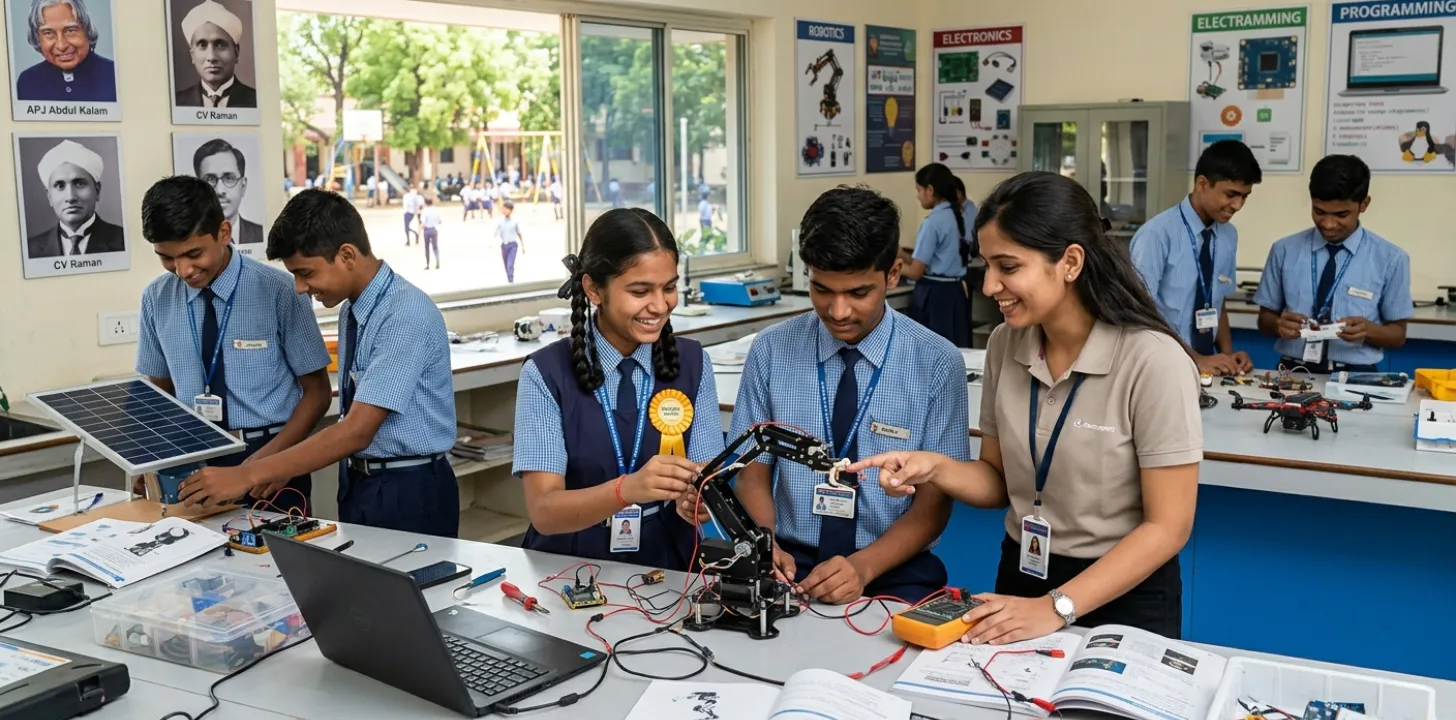
STEM labs in schools are a cornerstone of CSR giving in education, but the model needs rethinking. Many corporates fund lab construction but not lab activation. A lab with equipment that no teacher knows how to use is a storage room.
Effective lab programs combine hardware with teacher training, curriculum integration, and student engagement programs. Tata Trusts’ STEM programs, the Wipro Foundation’s Science Education initiative, and the Infosys Foundation’s programs are among the models worth studying, each of which links infrastructure to pedagogy.
The National Education Policy 2020’s emphasis on experiential learning, tinkering labs, and vocational integration creates a clear policy hook for corporates to fund lab programs that align with both NEP goals and STEM career pathways.
Scholarship Programs with Counselling Built In
Standalone scholarships, while valuable, are less effective than scholarship programs that bundle financial support with mentorship, internship opportunities, and community. When a student receives Rs. 50,000 a year but also gains access to a corporate mentor, an industry visit, and a peer network of fellow scholarship recipients, the impact compounds dramatically.
The Mahindra All India Talent Scholarship, Reliance Foundation Scholarships, and the Tata Scholarship Program for Cornell are frequently cited examples of programs that go beyond cheque writing. But the need vastly outstrips current supply, particularly for students in Class 11 and 12, the precise moment where STEM choices are being made.
Digital STEM Learning Platforms
For corporates whose CSR strategy includes digital education, the post-board period offers a natural enrollment window. Students who have just completed Class 10 and are awaiting or planning Class 11 enrollment are open to supplementary learning.
Supporting platforms like DIKSHA, SWAYAM, or partnering with organisations like STEMland, Avanti Fellows, or Shikshalokam to offer free or subsidised access to digital STEM content can dramatically expand reach. The key is alignment with board curriculum and the ability to function in low-bandwidth environments.
Industry Mentorship Programs
One of the most cost-effective, high-impact CSR interventions requires no infrastructure at all. It requires people.
Structured mentorship programs that connect STEM professionals, engineers, scientists, data analysts, doctors, architects with students from underserved communities can shift mindsets in ways that no brochure can. A 45-minute virtual conversation between a Class 11 girl in rural Rajasthan and a woman data scientist working at a Bangalore tech firm can rewrite what that girl believes is possible for her.
The investment is minimal. The return, in changed career trajectories, is significant.
The Particular Urgency: Girl Child in STEM
India’s gender gap in STEM is not a pipeline problem. It is an ecosystem problem.
Girls perform equally with or better than boys in Class 10 and Class 12 science examinations. The CBSE’s 2023 board result analysis shows girls outperforming boys in physics, chemistry, and mathematics in both Class 10 and 12. Yet by the time these students reach the workforce, their representation in STEM careers collapses.
The attrition happens in layers. After Class 12, a significant number of girls are steered away from STEM colleges due to family concerns about safety, distance, and costs associated with hostel accommodation. Those who do enroll face environments that are often unwelcoming, with low female faculty representation and limited peer community.
CSR interventions that are explicitly designed for girls in STEM can change this:
- Residential STEM bridge programs for Class 10 pass-outs from rural districts, giving girls two to four weeks of intensive science and technology exposure in a safe, supportive residential environment before they make their Class 11 choices.
- Women in STEM speaker series, delivered virtually to schools, featuring professionals across sectors, including women who did not go to elite institutions.
- Targeted scholarships that cover not just tuition but hostel costs, removing one of the biggest practical barriers for families.
- Peer learning networks that keep girls connected to each other and to mentors through their undergraduate years, addressing the isolation that often leads to dropout.
The case for this is not just social. A McKinsey Global Institute report found that advancing women’s equality in India’s economy could add $770 billion to GDP by 2025. STEM is one of the clearest paths to that parity, and corporate India has a direct interest in building it.
The CSR Partnership Model: Corporates, NGOs, and Schools Working Together
No single actor can solve this problem alone. The most effective STEM CSR programs operate through a three-way partnership model:
The Corporate brings: Funding, scale, employee volunteer networks, mentorship capacity, and industry credibility.
The NGO brings: Community trust, last-mile implementation expertise, relationships with government schools, and understanding of local context.
The School brings: Student access, teacher engagement, space, and the ability to embed programs into the academic calendar.
This triangulated model reduces the most common failure points in CSR education programs: corporates over-designing solutions without community input, NGOs under-resourced to scale, and schools receiving programs that don’t connect to their curriculum.
A practical example: A financial services firm funds a STEM career counselling initiative. They partner with an education NGO that has relationships with 200 government schools in three states. The NGO deploys trained counsellors, uses a curriculum co-developed with corporate volunteers, and conducts post-counselling follow-up to track student choices. The company’s employees participate as guest speakers and mentors. The school integrates the program into its annual calendar, ensuring sustainability beyond a single CSR event.
This model is replicable, scalable, and produces data that corporates can use to demonstrate impact.
Measurable Impact: The ROI of Investing in STEM Education
CSR in education is sometimes treated as a cost centre. It should be treated as a strategic investment with measurable returns, both social and business.
Here is how the ROI calculation works for STEM-focused CSR:
Talent Pipeline: Companies that invest in STEM education at the secondary and undergraduate level are building their own future talent pipeline. Infosys, TCS, Wipro, and HCL all operate programs that identify and support STEM students years before they enter the job market, creating brand affinity and recruiting advantages.
Measurable Social Return: The Social Return on Investment methodology, developed by the Social Value Lab, consistently shows that every rupee invested in quality career counselling for underserved students generates social value of Rs. 7 to Rs. 12 over a 10-year horizon, accounting for increased lifetime earnings, reduced public welfare dependency, and positive community spillover effects.
ESG and Reporting: As India’s SEBI Business Responsibility and Sustainability Reporting requirements become more rigorous, companies need demonstrable, quantifiable social impact in their annual reports. STEM education programs, especially those with longitudinal tracking, generate exactly the kind of outcome data that strengthens ESG profiles.
Employee Engagement: Corporate volunteer programs linked to STEM mentorship consistently rank among the highest-satisfaction CSR activities for employees. A 2022 Deloitte survey found that 70% of employees want to use their professional skills in volunteer activities, precisely what a STEM mentorship program offers.
Community Goodwill: In Tier 2 and Tier 3 markets where many large companies are expanding operations, genuine investment in local STEM education builds reputations that advertising cannot buy.
The metrics worth tracking in a STEM CSR program include:
- Number of students counselled versus those who subsequently enrolled in STEM programs
- Female enrollment rates in STEM courses in program schools versus control schools
- Scholarship utilisation and retention rates
- Mentee satisfaction and mentor engagement scores
- Teacher capacity improvement in STEM subjects
- Long-term career placement data, tracked at 2, 5, and 10 years
What Corporates Can Do This Month After Board Results
If you are a CSR head reading this in May or June, the window is open right now. Here is what you can do in the next 30 days:
Week 1: Audit and Map Identify the government schools within 50 kilometres of your company’s offices or plants. These are your primary intervention geography. Check if any of your existing NGO partners have relationships with these schools. If not, identify three NGOs working in education in those districts.
Week 2: Deploy a Career Counselling Event Partner with a trained career counsellor organisation to conduct a one-day STEM career awareness event for Class 10 and 12 students from two to three schools. Keep it practical: real careers, real salary ranges, real qualification pathways. No generic inspiration talks.
Week 3: Announce a Scholarship Window If your company runs scholarships, extend the application window for students who received results in the past 30 days. Most scholarship deadlines miss the post-board window entirely. This is a simple, low-cost fix.
Week 4: Launch a Mentorship Sign-Up Drive Internally Send an internal communication inviting employees with STEM backgrounds to sign up as mentors for students from underserved communities. Even 30 minutes a month per mentor, structured with a good program, creates measurable impact.
Ongoing: Commit to 12 Months, Not 12 Hours The biggest CSR mistake in education is event-based giving. Commit to a 12-month program cycle that begins with the post-board window and follows students through their academic year. Fund the follow-up, not just the launch.
Conclusion: The Time to Act Is Now, Not Next Quarter
India will add over 200 million young people to its working-age population by 2030. Whether they enter the workforce as STEM-ready professionals contributing to the digital economy, green transition, and healthcare innovation, or as underemployed graduates stuck in low-skill, low-wage cycles, will depend significantly on decisions made in the next five years.
And some of the most consequential of those decisions will happen in the next six weeks, as students across the country open their board result envelopes and ask: what now?
Corporate India has the resources, the expertise, the networks, and the genuine business interest to answer that question with something better than silence. CSR in education that is timed, targeted, and tied to STEM career pathways is not charity. It is strategic investment in the human capital that India’s next decade depends on.
The lab, the scholarship, the mentor, the counselling session: none of these require a new policy, a government mandate, or a long procurement cycle. They require will, a plan, and the recognition that the post-board window is not a news cycle moment. It is a life-changing inflection point.
The students are waiting. The window is open.
Frequently Asked Questions (FAQs)
Q1. What is the most effective CSR intervention for STEM education in India?
The most effective CSR interventions for STEM education combine multiple elements: career counselling delivered immediately after board results, infrastructure support in the form of functional labs with teacher training, targeted scholarships that include mentorship, and structured industry mentorship programs. Research shows that multi-component programs outperform single-intervention approaches because they address the interconnected barriers of awareness, affordability, access, and aspiration simultaneously. Programs that follow students longitudinally, rather than offering a one-time event, produce the most durable outcomes.
Q2. How can companies measure the impact of their CSR investment in STEM education?
Companies can measure CSR impact in STEM education through both output and outcome metrics. Output metrics include number of students counselled, labs established, scholarships disbursed, and mentors deployed. Outcome metrics, which reflect actual change, include the rate at which counselled students enroll in STEM programs, female enrollment in STEM courses at program schools, scholarship retention and completion rates, and longer-term career placement data. Social Return on Investment frameworks, used by organisations like the Social Value Lab and the Centre for Social Impact and Philanthropy, allow companies to quantify the economic value generated per rupee invested.
Q3. Why is the post-board results period particularly important for STEM career interventions?
The weeks immediately following board results represent a critical decision window when students are actively choosing their Class 11 stream or undergraduate program. Research in adolescent decision-making shows that young people are most receptive to new information during life transitions. Without intervention at this precise moment, students, particularly those from underserved backgrounds with limited access to career counselling, default to choices shaped by proximity and peer pressure rather than informed assessment of their aptitude and the labour market. Early intervention at this stage can redirect students toward STEM pathways before they are locked into misaligned choices.
Q4. What role do STEM role models play in encouraging girls to pursue science and technology careers?
STEM role models are among the most powerful tools for increasing girls’ participation in science and technology careers. Research consistently shows that girls are more likely to pursue STEM when they can see themselves represented in it. Women who work in STEM fields, particularly those from non-elite backgrounds and diverse geographies, when connected with younger girls through mentorship programs, speaker series, or even short virtual interactions, meaningfully shift what girls believe is possible for them. Corporates can create structured speaker series, virtual mentoring programs, and residential STEM camps specifically designed to connect girls from government schools with women professionals, addressing the representation gap that drives early dropout from STEM pathways.
Q5. How can small and mid-sized companies participate in CSR for STEM education without large budgets?
Small and mid-sized companies can participate in STEM education CSR through several cost-effective approaches. Pooling resources with other companies through industry associations or CSR consortiums allows smaller budgets to fund programs at meaningful scale. Employee mentorship programs require no capital expenditure and can be structured entirely around volunteer time. Partnering with existing NGOs that have established school relationships allows companies to fund specific program components, a scholarship batch, a counselling event, a lab activation, rather than building programs from scratch. Companies can also contribute in-kind by providing access to their facilities for student visits, their professionals for career counselling sessions, or their technology for digital learning programs. The key principle is that consistency and quality of engagement matter more than the size of the initial investment.